

How AI Is Transforming Software Development: From Coding Assistance to Intelligent Applications
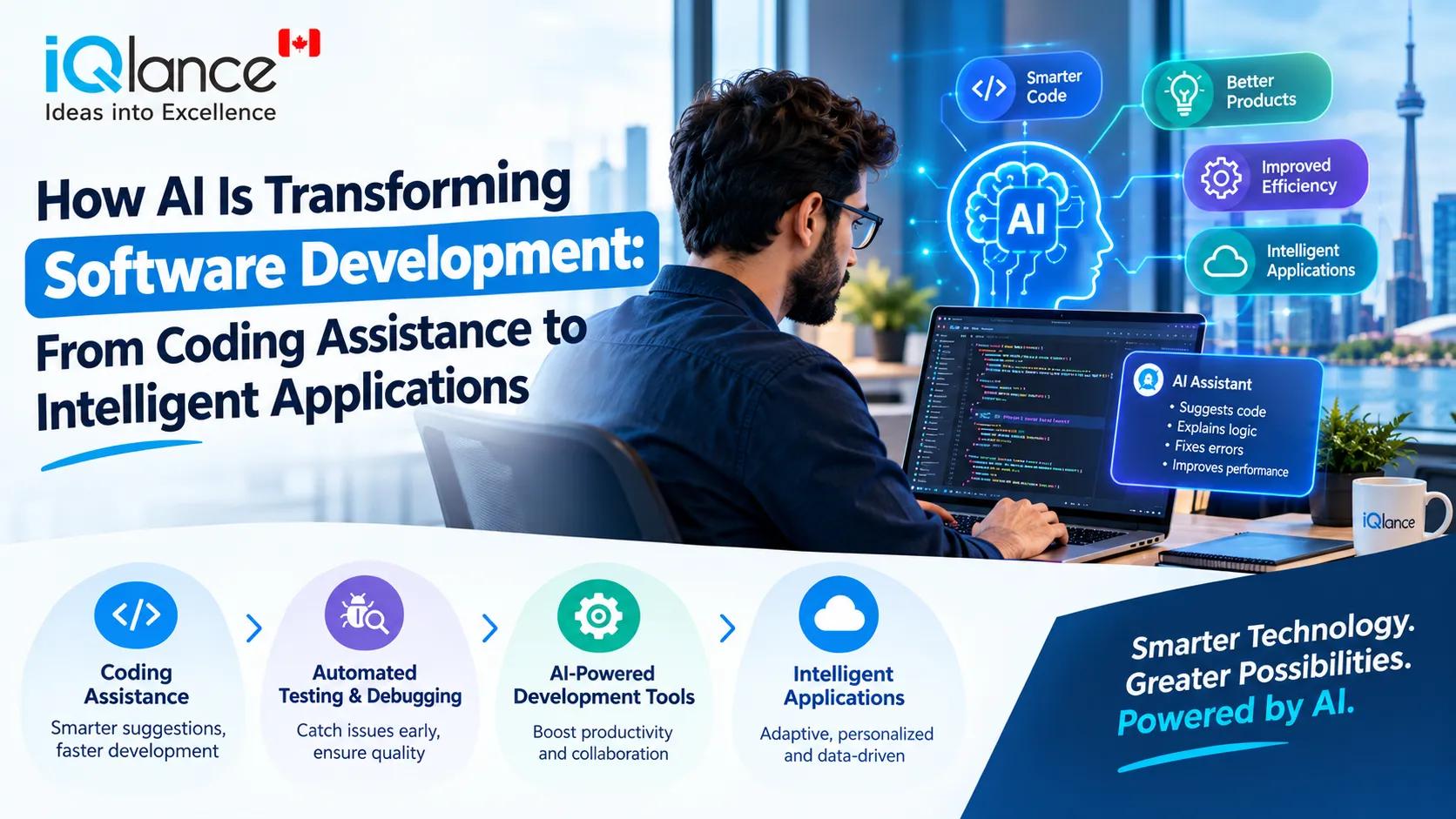
how-ai-is-transforming-software-development
Artificial intelligence is changing the way software is designed, developed, tested, and maintained. What was once limited to research and specialized applications is now becoming part of everyday software development workflows. Developers can use AI to generate code, identify potential issues, automate repetitive tasks, and work with large amounts of technical information more efficiently.
At the same time, AI is influencing the software products businesses build. Applications can now include intelligent search, recommendations, predictive analytics, conversational interfaces, automation, and other capabilities that were previously difficult or expensive to implement.
The result is a shift toward a more collaborative approach in which developers use AI as a productivity tool while continuing to provide the technical judgment, creativity, and oversight required to build reliable software.
How AI Is Changing the Software Development Process
Traditional software development involves several stages, including requirements gathering, planning, design, coding, testing, deployment, and maintenance. AI can contribute across many of these stages by helping teams analyze information and automate repetitive activities.
During the planning stage, AI tools can help organize requirements, summarize documentation, identify potential inconsistencies, and generate initial technical suggestions. During development, they can assist with code generation and optimization. Testing tools can help identify defects and create test cases, while AI-powered monitoring can support ongoing maintenance.
This does not mean that AI independently manages the entire software development lifecycle. Instead, it provides developers with additional capabilities that can make certain processes faster and more efficient.
AI-Assisted Coding and Developer Productivity
Coding assistance is one of the most visible applications of AI in software development. AI coding tools can suggest code based on a developer's instructions, existing code, or the surrounding development context.
Developers can use these tools to generate repetitive code, create functions, explain unfamiliar code, or suggest possible improvements. AI can also help with refactoring by identifying opportunities to make code more readable or efficient.
Another benefit is that developers can interact with some AI systems using natural language. Instead of manually searching through extensive documentation, a developer can describe a technical problem and receive suggestions or explanations.
However, AI-generated code still requires human review. Generated code can contain logical errors, security weaknesses, inefficient approaches, or assumptions that do not match the project's requirements. Developers therefore remain responsible for validating and integrating AI-generated output appropriately.
AI-Powered Software Testing and Debugging
Software testing is another area where artificial intelligence can provide significant assistance. Modern applications can contain thousands of components and complex interactions, making comprehensive testing challenging.
AI-powered testing tools can assist with generating test cases, identifying unusual behavior, analyzing test results, and detecting patterns that may indicate defects. AI can also help developers investigate errors by analyzing logs, code, and previous failures.
Automated debugging can reduce the time spent searching for the source of certain problems. Instead of manually reviewing every part of an application, developers can use AI to narrow down possible causes and prioritize areas that require attention.
Even so, AI should complement established testing practices rather than replace them. Human testing, security reviews, performance analysis, and business validation remain important for delivering dependable software.
Generative AI and Modern Software Development
Generative AI has expanded the role of artificial intelligence in development by allowing users to generate new content from natural-language instructions. In software engineering, this can include code, documentation, test cases, technical explanations, and development suggestions.
For example, a developer might ask an AI system to create a basic function, explain an API response, generate unit-test scenarios, or convert code from one programming language to another.
Generative AI can also help teams create documentation more efficiently. Developers can use it to summarize complex code or produce initial documentation that can later be reviewed and refined.
However, generated content should not automatically be treated as correct. Software teams need processes for reviewing AI output, checking dependencies, validating security, and ensuring that generated code follows project standards.
Building Intelligent Applications With AI
AI's impact goes beyond helping developers write software. Businesses are also integrating AI directly into applications to create more intelligent user experiences.
AI application development can include features such as personalized recommendations, conversational assistants, intelligent search, document processing, fraud detection, predictive analytics, and automated decision support.
Machine learning can help applications identify patterns in data, while natural language processing can enable systems to understand and respond to human language. Predictive models can help businesses forecast outcomes and make data-driven decisions.
These capabilities are creating a new category of intelligent applications that can adapt to user behavior, process information at scale, and support more personalized experiences.
The key is to select AI capabilities based on a genuine business or user need rather than adding AI simply because it is currently popular.
Key Benefits of AI in Software Development
The growing use of AI in software development can provide several potential advantages.
Faster development cycles: AI can automate repetitive activities and help developers complete certain tasks more quickly.
Improved developer productivity: Developers can spend less time on routine coding, documentation, and information retrieval and more time on architecture and problem-solving.
More efficient testing: AI can assist with test generation, defect detection, and analysis of testing results.
Automation of repetitive work: Tasks that require predictable patterns can often be supported by AI-driven automation.
More intelligent applications: AI enables products to offer features such as recommendations, natural-language interfaces, prediction, and intelligent automation.
Better use of development resources: By reducing time spent on certain manual activities, teams can potentially focus more resources on higher-value engineering and product decisions.
The actual benefits depend on how effectively AI tools are integrated into existing workflows and how carefully their output is reviewed.
Challenges and Risks of AI-Powered Development
Despite its advantages, AI-powered software development also introduces important challenges.
One concern is accuracy. AI systems can generate plausible-looking code that contains errors or does not fully understand the application's requirements. This makes human validation essential.
Security is another consideration. Developers must evaluate whether AI-generated code introduces vulnerabilities and carefully manage sensitive information used with AI tools.
Intellectual property and licensing can also require attention, particularly when teams use AI-generated or AI-assisted code within commercial products.
There is also a risk of overreliance. If developers accept AI suggestions without understanding them, teams may create technical debt or introduce problems that become more difficult to identify later.
For these reasons, successful AI adoption requires governance, code review, security practices, testing, and clear accountability.
How Businesses Can Adopt AI in Software Development
Businesses do not necessarily need to transform their entire development process at once. A practical approach is to identify specific areas where AI can provide measurable value.
Teams can begin with relatively controlled use cases such as documentation assistance, test generation, code explanations, or repetitive development tasks. Once developers become comfortable with these tools, organizations can evaluate more advanced applications.
Businesses should also establish guidelines for data privacy, security, code review, and responsible AI usage. Developers should understand when AI can be used and when human review or traditional development methods are more appropriate.
Most importantly, AI adoption should be connected to business objectives. The goal should not simply be to use more AI, but to improve software quality, development efficiency, user experience, or business outcomes.
The Future of AI and Software Development
AI is likely to become increasingly integrated into software engineering workflows. Development environments may provide more context-aware assistance, while AI systems become better at understanding project requirements, codebases, testing environments, and deployment processes.
The industry may also see greater growth in AI-native applications designed around intelligent capabilities from the beginning rather than adding AI to an existing product later.
However, the growing role of AI does not eliminate the need for software developers. Human expertise remains essential for architecture, product decisions, security, ethical considerations, business understanding, and complex problem-solving.
The future is therefore more likely to involve collaboration between developers and AI systems rather than complete replacement of developers.
Conclusion
AI is transforming software development at multiple levels, from coding assistance and automated testing to the creation of intelligent applications. It can help developers reduce repetitive work, improve productivity, analyze complex information, and build new types of digital experiences.
At the same time, AI introduces challenges involving accuracy, security, privacy, intellectual property, and overreliance on automated output. Organizations need to approach AI adoption thoughtfully, combining its capabilities with established engineering practices and human expertise.
As AI technology continues to mature, software development will increasingly become a collaborative process in which developers use intelligent tools to work more efficiently while remaining responsible for the quality, security, and direction of the software they build.